The shipping forecast is transmitted several times a day and night. It is structured very precisely and uses key words and terms to express the weather into as few words as possible. The natural flow of words like ‘imminent’, ‘variable’, ‘later’, ‘force 3 to 4’, and ‘westerly or southwesterly’ makes it very soporific. Today’s forecast had the words ‘variable’ and the dreaded ‘foggy patches’.
Shipping forecast information
The shipping forecast is issued four times a day at 2300, 0500, 1100, 1700 UTC and covers a period of 24 hours from 0000, 0600, 1200 and 1800 UTC respectively.
The waters around the British Isles are divided into 31 sea areas shown on the map.
The forecast contains details of gale warnings in force, a general synopsis and sea-area forecasts containing wind direction and force, sea state, weather and visibility.
Gale warnings are issued as required throughout the day (for winds of Gale Force 8 or more).Met Office
09:00 Our hunt for fuel is coming to an end – an appointment to fill up is here and now. “Where is the attendant as promised?” After a call on the radio, a smartly dressed fella arrived. Tank 100%.
09:30 We set off in the light winds and motored out to sea. The foggy conditions began from the onset and visibility was pretty poor. Our AIS and electronic chart kept us safely on course. Happy days: a full tank of fuel, smooth seas, and the course set for Salcombe and beyond.
That’s until the electronics began to falter, one section then another. We eventually even lost the autohelm and AIS points of vessels around us. We segued back to manual helming and followed the ship’s compass for directional control. Surrounded by mist, our outlook had shrunk. Miraculously, a systems reboot returned everything to normal. Phew!
10:30 The winds increased by a couple of knots (11kts), so time to raise Code 0. Yes, it works and with the tide still against, we made slow progress (3.5kts) towards Start Point. Not a problem because we had all day to get as far west as possible. Mist turned to haze, the skies above cleared, and the sun shone down from above.
14:20 We gybed just as the tide changed in our direction and almost instantly the boat speed doubled to 6kts. This new course had also increased our AWS (apparent wind speed) and we comfortably sailed on a beam reach. Perfect!

Winds variable

17:00 And now everything changed as the shipping forecast had predicted: winds variable, and foggy patches. As the wind speed decreased we lowered the sails. Look how variable the direction is on the screen. From a steady 55° to 310° to 100° within 15 minutes. Not ideal.
And then worst of all, we entered a bank of dense fog. A real pea souper with nil visibility. Unbelievably it arrived as we crossed the main shipping channel into Plymouth and worse still, a warship was manoeuvring in a haphazard way in the bay. Radar was switched on and we continued towards the safety of Cawsand Bay, where another warship was at anchor. Our eyes were totally focused on the radar screen and the view of only 20 metres in front.


HMS Iron Duke warship link to Royal Navy.
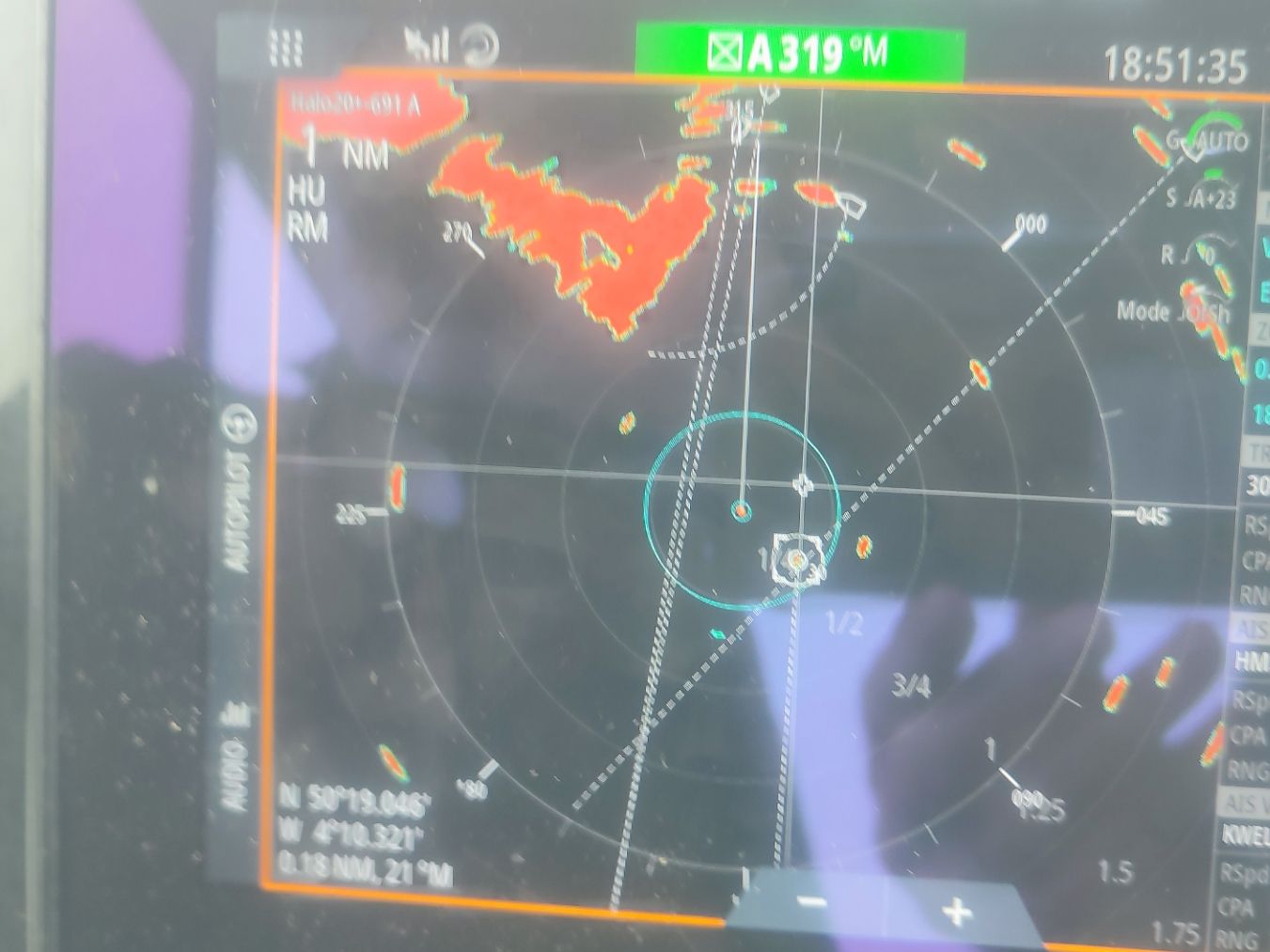

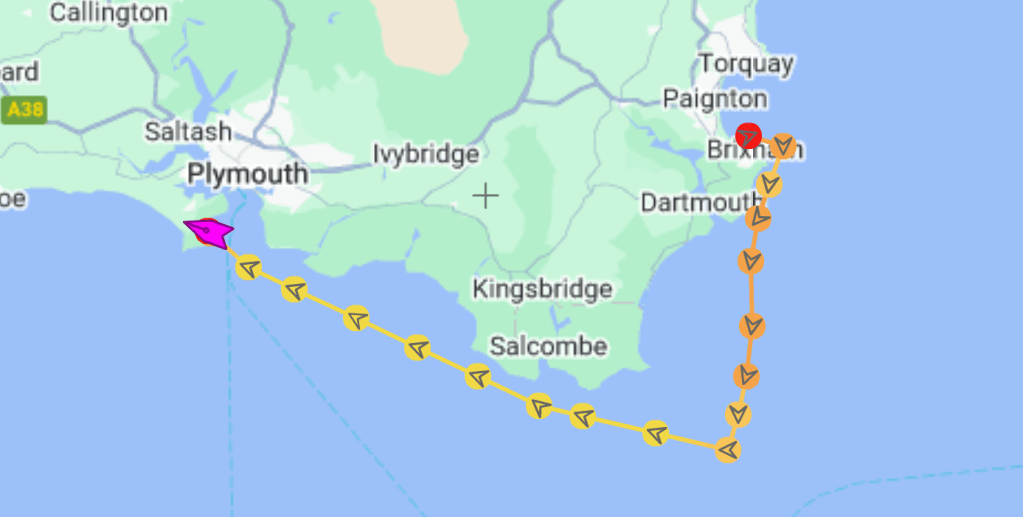
19:10 Anchored in 8 metres. No two days are the same. And foggy days are the worst of them. Relax!
The constant loud blasts of foghorns and clanging bells filled the night air as warships continued to practice nearby in the dark.
Tomorrow is another day…

Vessels Underway (Power-driven):
Making way:One prolonged blast at intervals of not more than two minutes.
Vessels at Anchor in fog:
General:
A rapid ringing of a bell for about five seconds at intervals of not more than one minute.Editor
Zzzz
 Experience Sailing